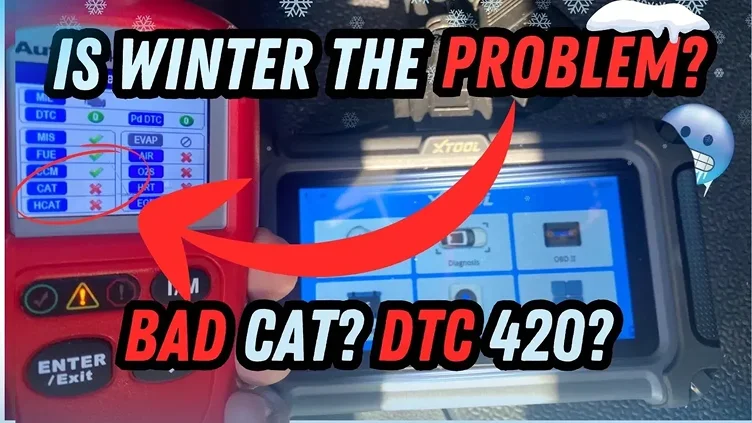
Winter often brings up questions about the Catalyst monitor, especially when it’s hard to set and monitor readiness. Many drivers struggle with this process, and in today’s post, I’ll answer the top five questions I get asked regularly. Whether you’re using a basic OBD2 reader or a more advanced scan tool, I’ll help you save time and money by explaining how to handle common issues.
Watch the full video HERE.
1. My Check Engine Light is On – Should I Continue the Drive Cycle?
One of the most common questions is whether you should continue your drive cycle if the check engine light (CEL) turns on. If the light comes on during your drive cycle, stop immediately. This indicates an issue, possibly one you’ve had before, and continuing to drive without fixing it can waste your time and money. Use your OBD2 reader to check the code and see if it’s related to the same issue you cleared earlier. If it is, fix the problem before continuing.
However, if the light stays off for a long time and then turns on later in the cycle, there may still be hope, and I’ll discuss that later.
2. Should I Continue with a Pending DTC?
If a pending diagnostic trouble code (DTC) appears during your drive cycle, stop and address it. A pending DTC is a warning from the vehicle that it has detected an issue but hasn’t confirmed it yet. If the same issue triggers again, you’ll need to fix it. Continuing with a pending DTC won’t help, as it’s essentially just a matter of time before it becomes a full issue, wasting more time and fuel.
3. The Catalyst Monitor Goes Incomplete – What Should I Do?
One of the most frustrating things that can happen during a drive cycle is when the Catalyst monitor shows as incomplete, even though it was previously ready. This often happens in winter, as people skip warming up their cars before driving. Warming up the car for 15–20 minutes helps ensure the catalyst reaches the right temperature for testing. In cold weather, this process is even more important, as it allows the exhaust system to reach optimal heat levels.
Don’t rush through this; allowing your vehicle to warm up might just be the trick to getting the Catalyst monitor to pass. It’s one of the most effective, no-cost solutions.
4. The Catalyst Won’t Get Ready – How Can I Help It?
If your vehicle’s Catalyst monitor won’t set ready, even after a good warm-up cycle, you may need to help it along by increasing the heat in the exhaust system. This can be done by driving on a hill or incline, as this increases the load on the engine and helps generate more heat. If you don’t have access to hills, driving more aggressively after warming up the engine might help.
Fuel additives like pure gasoline or specific fuel additives can also help, especially if your catalyst is marginal. However, nothing beats the effectiveness of a proper warm-up. Keep in mind that ethanol-free fuel can also help, as it burns hotter and is better for your system.
5. The Vehicle Throws Off a CEL Right Away (P0420, P0430, etc.) – What Should I Do?
If the check engine light triggers immediately after you begin a drive cycle, and the code is related to the catalytic converter (such as P0420 or P0430), this could indicate a serious issue. The catalyst may be damaged or even destroyed.
In this case, there are a few things you can try. First, check the exhaust system for leaks. A leak can lead to inaccurate readings from the oxygen sensors, which may trigger the CEL. If the O2 sensors haven’t been replaced in a long time, it might be worth replacing them, as old sensors can give incorrect data.
If the catalyst is physically damaged (for example, if the honeycomb is broken or there’s oil or coolant contamination), a cleaning procedure or replacement may be necessary. Some solutions involve chemicals that can flush out the catalyst, which can be done without removing it, but it’s a temporary fix.
If none of these methods work, replacing the catalytic converter may be your only option. However, before investing in a new catalyst, make sure that the oxygen sensors and exhaust system are in good condition.
Final Thoughts
Understanding how to properly set the Catalyst monitor and ensure your vehicle passes the emissions test can be tricky, but with these tips, you should have a clearer path forward. A little preparation, some patience, and attention to detail can save you time and money. If you’re dealing with a tough case, remember that a proper warm-up and regular maintenance are key to keeping your vehicle’s systems running smoothly.