On a modern plug-in hybrid, EV, or late-model vehicle, a weak or aging 12-volt battery rarely gives you a simple click-no-start and calls it a day. Instead, low voltage triggers phantom check engine lights, EVAP glitches, weird transmission shift behavior, or ABS and hybrid warnings that make you think a major module is failing.
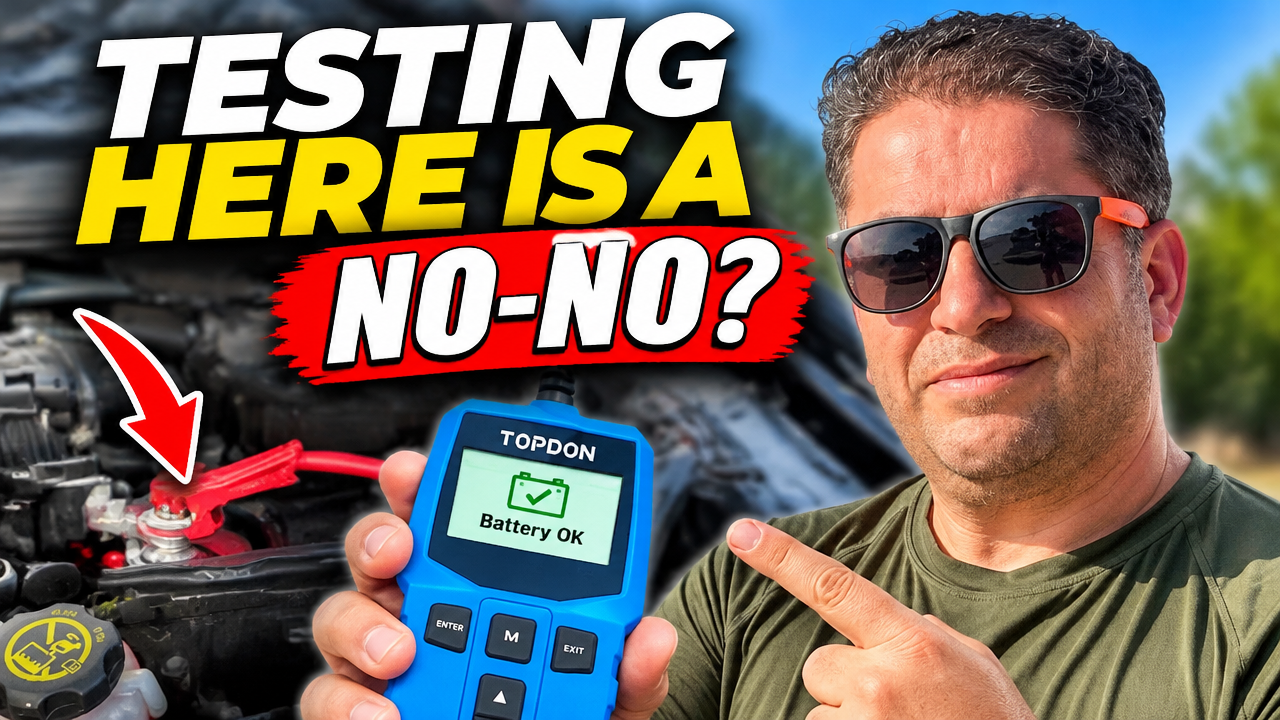
Testing with a standalone tool like the TOPDON BC100—which needs no phone app and measures internal resistance directly—reveals a critical mistake that has likely cost the DIY community millions of dollars in false-negative “bad battery” diagnoses and premature replacements.
Watch the full side-by-side testing and hybrid load-test walkthrough in the video below:
Why Testing at the Jump Post Fails (The Million-Dollar False Negative)
Modern vehicles pack dozens of control modules, relays, and high-amp fuse blocks powered by a 12V battery that often sits tucked away in the trunk, under a floor pan, or beneath a seat—far from the front jump-start terminals.
When you clamp a battery tester onto the front positive and negative jump posts instead of the battery itself:
-
Line Length & Resistance Add Up: Long cable runs, junction blocks, and multiple connection points introduce extra resistance and voltage drop between the jump post and the battery terminals.
-
False “Bad Battery” Readings: That added resistance skews conductance and internal resistance readings. Even a healthy 12V battery—such as a 680 CCA / 60 Ah AGM battery in a Chevy Volt or a nearly new 850 CCA AGM battery in a 2024 Sprinter—can read as “bad” at the front jump posts, only to test completely healthy when clamped straight onto the actual battery terminals.
-
Clamp Design Checks: Dual-jaw clamps built to verify contact on both sides of a post or stud won’t even let you test improperly from awkward front points on certain setups, forcing you back to the real source.
The rule: Always test directly on the actual 12V battery terminals (after checking the rated CCA or Ah and chemistry—AGM flat plate, spiral/Optima-style AGM, or flooded lead-acid), and make sure clamps grip solidly without wiggling.
DIY Hacks for Hybrids, EVs & Older Lead-Acid Batteries
1. Hybrid & EV 12V Load Test Hack (No Starter Motor Needed)
Hybrids and EVs don’t spin a traditional 12V starter motor the way a standard gas engine does, which can throw off automated cranking/charging tests with voltage spikes. Here is a practical DIY load test workaround:
-
Turn Ignition ON Without
READYMode: Press the power button without pressing the brake pedal so accessories and modules wake up without engaging drive/hybrid propulsion. -
Stack On Electrical Loads: Switch on headlights, rear defrost, or other high-draw accessories to put real demand on the 12V battery.
-
Watch Voltage Under Load: Check that the battery holds above 11.5 volts for at least a minute. If voltage drops below 11.5V under load, the battery is nearing the end of its useful life.
2. Reviving & Maintaining Flooded Lead-Acid Batteries
On older flooded lead-acid batteries—like a 275 CCA lawn mower battery that sat dead or developed sulfation—a battery desulfator connected over a couple of days can help break down sulfate buildup and restore performance. Also, avoid testing a battery the instant it comes off a charger while surface voltage is artificially high; let surface charge settle first so the tester gives an accurate read.
-
🛒 TOPDON BC100 Battery Tester: Buy Here
-
🛒 Battery Desulfator (Shown in Video): Buy Here
-
▶️ Refill & Maintain 12V Lead-Acid Batteries: Watch the Walkthrough
Real-World Glitches & Why a Pocket Tester Pays Off
Keeping a compact tester in the trunk prevents expensive parts cannons. When a cold snap hit a 2014 Dodge Caravan, a weak 12V battery triggered EVAP-related check engine lights while the vehicle sat overnight running automated self-checks—issues that cleared up once the weak battery was addressed. Across years of shop work, plenty of “bad transmission” complaints turned out to be tired 12V batteries starving modules of clean power.
Watch the full video above to see the jump-post vs. battery-terminal tests, hybrid 12V load check, and mower battery test in action!