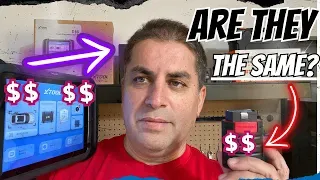
When it comes to diagnosing car problems, technology has brought us a wide range of tools to make life easier. Today, we’re comparing traditional scan tools with app-based diagnostic devices that connect to your smartphone via Bluetooth. With more car owners looking for convenient and affordable solutions, the question arises: Can your phone-based scan tool really replace a dedicated diagnostic scanner?
Let’s dive into the pros and cons of both options to help you make the best choice for your needs.
Watch the full video HERE.
Traditional Scan Tools vs. App-Based Scan Tools
1. Compatibility and Vehicle Coverage
If you own a vehicle from 1996 or newer, both traditional scan tools and app-based tools can read and clear codes from your car’s computer. However, for older vehicles, you may run into compatibility issues with app-based devices. Traditional scan tools, particularly the higher-end models, often come with adapters that allow them to connect to legacy ports, making them more versatile for a broader range of cars, especially older ones.
In contrast, app-based tools like BlueDriver, ThinkCar, or Topdon are designed for modern cars and might not be useful for cars that are pre-1996. This can be a significant drawback if you work on a wide variety of vehicles or plan to use the tool professionally.
2. Functionality and Performance
App-based scan tools excel in basic functions like reading and clearing codes, which is great for hobbyists or people looking for a budget-friendly solution. However, modern cars have numerous computers and complex systems that can’t be properly diagnosed with these simple tools. Newer cars require more advanced functions, such as bi-directional control, where you can send commands to the car’s systems, like testing a component or relearning a throttle body.
While app-based tools can handle the basics, they often lack the depth and accuracy of traditional scanners when it comes to advanced diagnostics. For example, a traditional scanner like the XTool D8S can handle more complex tasks like graphing multiple sensors at once, a feature often missing from app-based tools.
3. Accuracy and Reliability
One key advantage of traditional scan tools is their reliability. They are purpose-built devices designed to interface seamlessly with a vehicle’s onboard computer systems. When dealing with critical car issues, you want a tool that won’t fail on you—especially if you rely on it daily or for more complex repairs.
In one example, a misstep with an app-based tool resulted in the throttle body and accelerator pedal failing to communicate properly after a throttle body relearn procedure, leaving the car immobile. Such issues are less likely with traditional scan tools, which are generally more stable and less prone to glitches.
4. Ease of Use
App-based tools offer a level of convenience that traditional scan tools can’t match. You can simply plug them into the OBD2 port, pair them with your phone, and access the data on an app. But this ease of use comes with limitations. If you receive a phone call or notification while performing diagnostics, it could interrupt the process, which can be especially problematic if you’re dealing with sensitive procedures.
On the other hand, traditional scan tools provide a larger, dedicated screen, making it easier to read data and perform diagnostics without interruptions. Additionally, they often come with physical buttons and built-in software tailored for diagnostics, giving you a more stable, distraction-free experience.
5. Cost
There’s no denying that app-based scan tools are cheaper upfront. With prices ranging from $30 to $100, they provide an affordable solution for basic diagnostics. However, traditional scan tools, while more expensive, often come with multiple years of software updates and cover a wider range of functions.
Long-term, a traditional scan tool may save you money by providing more accurate diagnoses, reducing the need to “throw parts” at a problem. In contrast, app-based tools might misdiagnose certain issues, leading to unnecessary repairs and higher costs.
6. Advanced Features
When it comes to features, traditional scan tools have a clear edge. They can offer advanced graphing, which is crucial for diagnosing intermittent problems or complex systems. Many high-end scanners can graph multiple data streams simultaneously, making it easier to pinpoint issues.
App-based tools, while improving over time, generally lack robust graphing capabilities and advanced features like coding or programming that are essential for in-depth diagnostics. If you’re serious about auto repair, particularly on newer, more complex vehicles, investing in a traditional scan tool is a smart choice.
Conclusion: Which Scan Tool is Right for You?
If you’re looking for a quick, budget-friendly solution for basic diagnostics on newer cars, an app-based scan tool may work just fine. They’re easy to use, portable, and can provide basic functions like reading and clearing trouble codes. However, if you’re dealing with more complex issues or want a tool that can grow with your knowledge and needs, a traditional scan tool offers far greater reliability, advanced features, and long-term value.
Ultimately, the right tool depends on your specific needs and how much you’re willing to invest upfront. If you prioritize accuracy, advanced diagnostics, and long-term savings, a traditional scan tool like the XTool D8S is the better choice. For casual users or those working on basic car repairs, an app-based tool can offer the convenience you need without breaking the bank